Finstown Substation, Orkney
Category: Industrial / Energy Infrastructure
Company: BT Bell Consulting Engineers
Status: In construction (2026)
Client: SSE Transmission
The Finstown Substation forms a critical part of the £900 million Orkney–Caithness 220 kV subsea link — the first connection between the Orkney Islands and Great Britain’s national transmission network. Once complete, the project will enable up to 220 MW of renewable energy to be exported, supporting Scotland’s net-zero strategy and strengthening the UK’s energy security.
BT Bell were responsible for delivering the full earthworks, access road, and drainage design, using Site3D to model a highly complex site with challenging topography, sensitive environmental constraints, and a demanding construction programme.
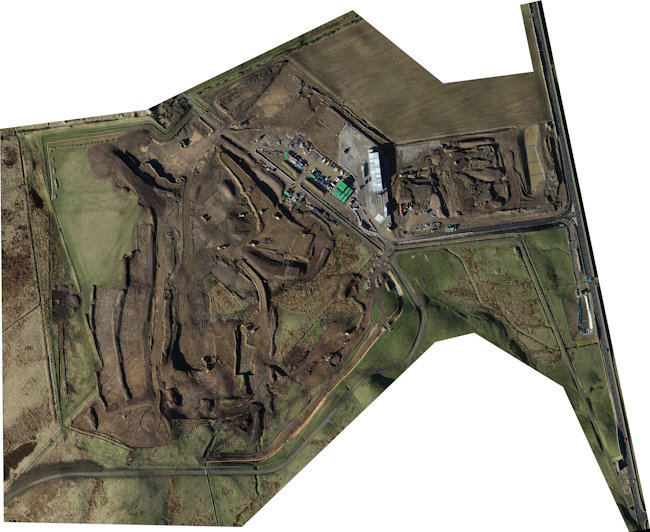
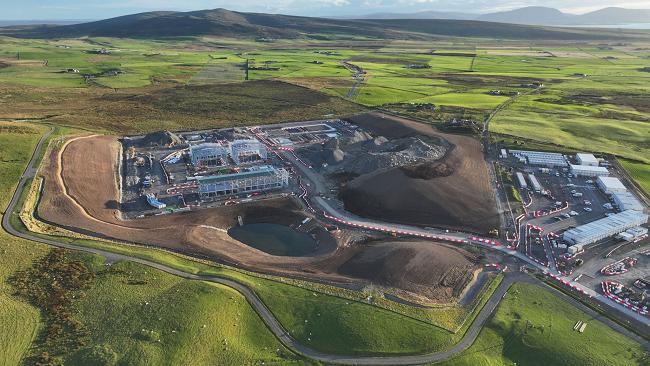
Drone imagery of the initial site earthworks
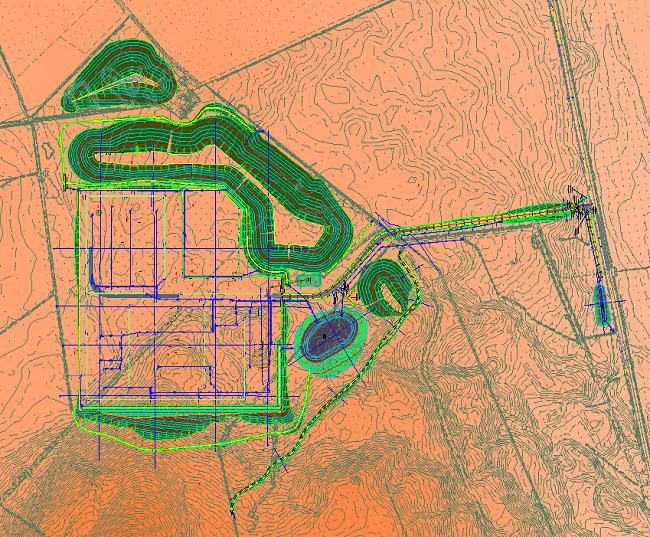
Site3D plan view screenshot of design elements
Project Scope
- Creation of a 250m × 250m level platform cut into natural slopes.
- Approx. 300,000 m³ of cut earthworks, with material re-use on site.
- Design of a 400m access road capable of accommodating specialist multi-axle transformer delivery vehicles.
- Full drainage strategy, including 4 km of piped drainage and a 7,500 m³ attenuation pond.
- Detailed 3D coordination with ducts, drawpits, utilities and high-voltage cables.
- Modelling of screening bunds to minimise visual impact.
- Groundwater modelling using borehole data to inform drainage and attenuation design.
Challenges
Minimising Visual Impact on a Sensitive Landscape
The substation sits within an exposed island environment, making visual impact one of the project’s highest priorities. BT Bell worked with landscape designers to model a network of screening bunds shaped to mimic the surrounding Orkney landforms.
Using Site3D’s earthworks tools, the team quickly iterated through multiple geometry options, obtaining instant cut/fill volumes for each revision. This enabled near-real-time feedback to the client, and resulted in a solution that reused the vast majority of the 300,000 m³ of site-won material, avoiding costly off-site disposal.
Complex Groundwater Conditions
Groundwater behaviour on the site proved highly challenging, requiring a detailed understanding of flows and interaction with the drainage network.
BT Bell used Site3D’s borehole modelling tools to build a comprehensive 3D geological model, which in turn informed a full hydrogeological flow model. This integration allowed the drainage design to be developed with confidence, ensuring resilience against groundwater uplift and seasonal variations.
High-Level 3D Coordination
As a major energy infrastructure project, the site contains extensive buried services and high-voltage assets.
BT Bell designed the entire drainage network within Site3D and exported IFC models into the federated site model. This prevented clashes with ducts, drawpits, HV cables and structural elements, giving the design team clear spatial understanding and helping the contractor mitigate buildability risks before construction began.
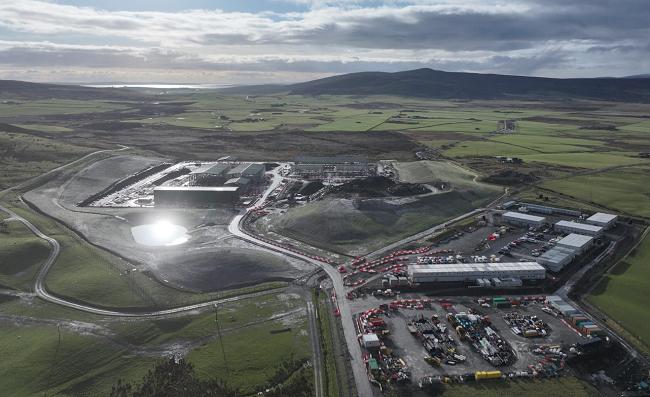
Photo illustrating the surrounding landscape.
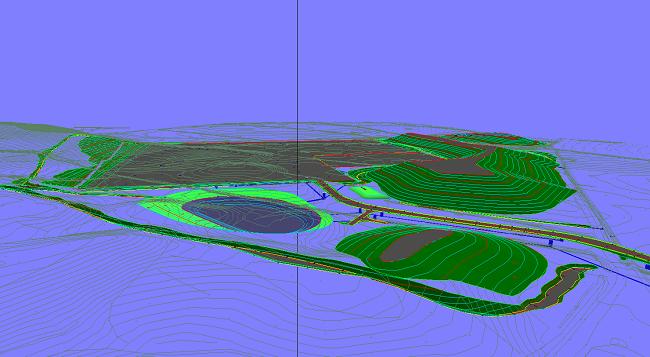
Site3D screenshot showing 3D view of the pad and earthworks design
Merits of the Design
The combined earthworks, drainage and access road design delivered by BT Bell ensures that this nationally significant project can proceed while respecting the surrounding environment and community. Key outcomes included:
- Sensitive visual integration, thanks to the detailed bund modelling.
- Efficient material re-use, dramatically reducing transport and disposal costs.
- Robust drainage design, supported by groundwater-informed modelling.
- High-accuracy 3D coordination, minimising construction risks and rework.
- Safe access for oversized transformer vehicles, through precise geometric modelling of road alignments.
Site3D’s rapid earthworks updates, borehole modelling, and detailed IFC outputs played a central role in enabling BT Bell to deliver the design effectively, on a site where accuracy and coordination were essential.
Conclusion
The Finstown Substation project demonstrates how Site3D supports large, complex infrastructure schemes where environmental constraints, earthworks volume accuracy, and meticulous 3D coordination are critical.
Through efficient modelling workflows and integrated geological and drainage tools, BT Bell were able to produce a design that is technically robust, environmentally sensitive, and aligned with the needs of a long-term national infrastructure investment.
Drone photo of the Finstown site in construction.